

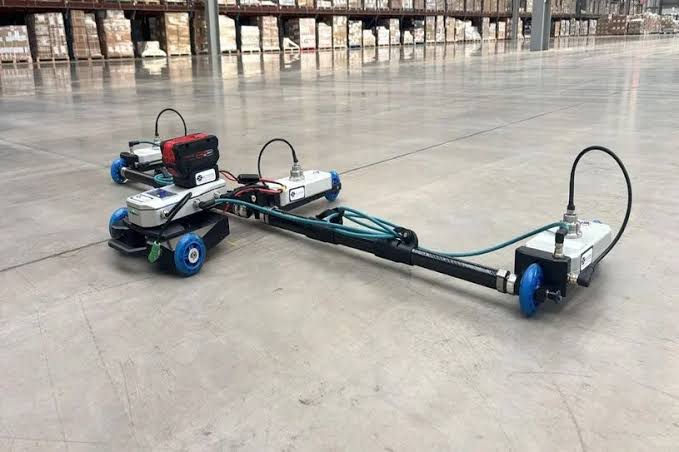
How targeted resin injection can restore support beneath industrial slabs while keeping the diagnosis focused on the ground rather than the surface damage
A moving forklift is an unforgiving instrument. When its wheels cross a joint and the slab rocks beneath them, the driver feels what a level survey may later confirm: the floor is no longer receiving uniform support from the ground below.
The first visible damage is often at the surface. Joint arrises begin to spall. Cracks widen. Adjacent panels develop a step. Racking, conveyors or sensitive machinery may move out of tolerance.
Yet replacing the damaged concrete before stabilising its support can condemn the repair to the same loading cycle that caused the failure.
Warehouse floor settlement is therefore a ground engineering problem as well as a flooring problem. The repair has to distinguish deterioration within the slab from loss of support beneath it, then address both in the correct order.
Why an industrial slab starts to rock
An industrial floor distributes wheel loads and static loads into the sub-base and underlying ground. Its performance depends on the slab thickness and reinforcement, joint design, surface regularity and the stiffness of the supporting layers.
When contact is lost beneath part of a panel, wheel loading causes repeated vertical deflection. The familiar knocking or rocking at a joint is sometimes described as slab pumping or rocking slab behaviour.
Several mechanisms can create that loss of contact. Poorly compacted fill may continue to consolidate after construction. Water from defective drainage or failed joints can migrate through the build-up and carry fine particles away.
Repeated heavy traffic may rearrange loose supporting material. Curling or warping of the concrete panel can lift an edge even where the sub-base was initially sound.
Once movement begins, the deterioration tends to reinforce itself. Impact at an uneven joint damages the arris, damaged joints admit more water and debris, and repeated wheel passages enlarge the unsupported zone.
A patch at the surface can improve ride quality for a time, but it cannot fill a void beneath the slab.
Diagnosis before industrial floor repair
The investigation should begin with the operation. Traffic routes, axle loads, racking lines, machinery bases, drainage runs and previous repairs help explain why distress is concentrated in particular areas.
A visual survey records cracks, joint damage and spalling, while level data identifies settlement and steps between panels.
Movement testing is equally important. Deflection across a joint under a known moving load can distinguish an active support problem from old cosmetic damage. Hollow-sounding areas may help map possible loss of contact, although acoustic response alone cannot define the depth or cause of a void.
The ground model may require cores, dynamic probing, drainage surveys or geophysical investigation. The objective is to establish whether the defect lies immediately beneath the slab, within the granular sub-base or deeper in the ground.
Resin type, injection depth and point spacing must follow that diagnosis.
Two different treatment geometries
Slab stabilisation commonly uses one of two layouts. Where an isolated panel or wider floor area has lost support, injection points are arranged in a grid adapted to the slab geometry and the identified treatment zone. The aim is to restore contact and improve the supporting material across the panel.
Where movement is concentrated along joints, points can be staggered on both sides of the joint. This targets the bearing zone beneath the panel edges and helps reduce differential movement between neighbouring slabs.
The spacing is designed for the site; a standard grid should not be applied without considering slab thickness, joint arrangement, utilities and the depth of weak material.
Small-diameter holes are drilled through the floor and injection tubes are installed to the selected depth. Expanding resin is then introduced in controlled increments.
In open spaces it can provide void filling; under confinement it develops reaction against the surrounding material and may compact or reinforce the treated zone, depending on the soil and resin formulation.
Control matters more than visible lift
Laser monitoring tracks the slab response during injection. The first upward movement can show that accessible void space has been taken up and contact has been re-established.
Where slab lifting or re-levelling is part of the design, injections can continue in carefully controlled stages.
A lift is not always desirable. Racking, fixed plant, walls, services and adjacent panels may restrict movement, while a cracked or heavily deteriorated slab may not tolerate attempts to recover its original level.
In many warehouse floor repairs, stabilisation is the objective and lift is simply the stop signal.
The site team should record injection location, depth and material volume alongside the monitoring data. Follow-up movement testing, levels or probing can then verify the result against the project criteria.
This evidence is more useful than a promise that every slab can be lifted to datum.
Repairing the cause as well as the support
Resin injection does not remove the need for conventional repairs. Failed drainage should be corrected. Broken joint shoulders may need to be cut back and rebuilt with a suitable repair material. Sealants and load-transfer details may require renewal.
Severely fractured panels can still require partial or complete replacement.
The sequence is decisive. If continuing water ingress is washing fines from beneath the slab, the water source must be controlled. If the slab is structurally inadequate for the imposed loads, restoring support will not change its bending capacity.
Conversely, replacing sound concrete over an untreated void spends capital on the visible layer while leaving the initiating defect in place.
A coordinated repair separates these functions: drainage controls the source, ground improvement restores support, joint repair protects the edges and slab replacement deals with concrete that no longer has adequate structural integrity.
Evidence from a logistics centre
A GEOSEC group project at a Spanish logistics centre illustrates how the method can be phased around an operating site. Heavy vehicle traffic and weather exposure had contributed to cracking, damaged joints and loss of uniform support around the external warehouse slab.
The specified treatment used GEOSEC’s Soil Stabilization process with expanding synthetic resin. Small holes were drilled through the pavement and injection points were arranged either in an approximately one metre grid beneath slab panels or at roughly 1.20 metre intervals along panel joints.
Injection took place at an approximate depth of 500 millimetres from the upper slab surface, with laser monitoring throughout.
The reported phase treated 657 square metres of slab and 779 linear metres of joints in ten working days, using one technician and two specialist operatives. A subsequent phase addressed a further 876 linear metres of internal joints.
These figures describe one project, not a universal production rate. Access, slab construction, ground conditions and verification requirements determine the programme on each site.
The operational case for limited disruption
For a distribution business, the direct repair price is only part of the cost. Closed aisles, relocated stock, interrupted loading bays and restricted forklift routes can exceed the value of the physical works.
Small injection holes and hose-fed equipment allow slab stabilisation to be divided into work zones and, where the risk assessment permits, coordinated with shifts or quieter operating periods.
That does not mean every intervention is disruption-free. Plant needs safe access, injection zones require exclusion, and the operator must manage traffic interfaces.
The advantage is that the treatment footprint can be localised and reopened progressively rather than requiring wholesale excavation of a large floor area.
For facilities managers, the most useful tender comparison therefore includes programme, affected operating area, curing or reopening constraints, verification and the risk of repeat failure.
Comparing only the contractor’s headline price can obscure the commercial effect of downtime.
When resin injection is appropriate
Expanding resin injection is well suited to localised void filling, loss of slab support and weak or poorly compacted material that can be treated at an accessible depth. It can also be useful where excavation would interfere heavily with warehouse operations.
It is less likely to be the complete solution where the slab has widespread structural failure, the weak ground extends beyond the practical treatment depth, ongoing drainage defects remain unresolved or new loads exceed the capacity of the original floor.
In those cases, reconstruction, piles, load redistribution or a combined scheme may be required.
A technically credible slab stabilisation proposal should explain the failure mechanism, the target layer, the injection geometry, the monitoring method and the acceptance criteria.
If those elements are missing, the client is being asked to buy material rather than an engineering outcome.
A floor repair should begin beneath the floor
Rocking joints and broken arrises are operational warnings. They show where the floor is reacting badly, but the durable repair depends on finding why support has been lost.
Targeted resin injection offers a way to fill voids and stabilise the ground through a small working footprint. Its strongest case is made through diagnosis, controlled installation and documented verification, combined with drainage, joint or concrete repairs where those are needed.
The forklift may be the first to detect the movement. Ground engineering should determine how it is stopped.
Frequently asked questions
What causes warehouse floor settlement?
Common causes include poorly compacted fill, consolidation, leaking drainage, washout, repeated loading and loss of contact caused by slab curling. More than one mechanism may be present.
Can resin injection lift a concrete slab?
Controlled lift may be possible where the slab condition, geometry and surrounding constraints permit it. Many schemes aim only to restore support and stop movement.
Does the warehouse need to close?
Often the works can be phased in local zones, but safe access and exclusion areas remain necessary. The method statement should be coordinated with the site’s traffic and operational plan.
Is void filling enough to repair damaged joints?
No. Void filling or ground improvement restores support. Spalled concrete, failed sealants, drainage defects and damaged load-transfer details may need separate repairs.
